 Alessandro Romano · ·
A standard padel court measures 20 metres long by 10 metres wide (about 65 ft 7 in × 32 ft 10 in) inside the walls, for a playing surface of 200 m². The net is 88 cm high at the centre, the back walls stand 4 m high, and the International Padel Federation (FIP) asks for at least 6 m of clear height above the court. Allow about 21 × 11 m of land per court once the structure is included.
Whether you are planning a new club, adding courts to a tennis club or simply curious about the lines you play on, this guide goes from the playing surface outwards: the lines, the net, the walls, the space above, and the land around a court.
The playing area: 20 × 10 metres
A doubles padel court measures 20 × 10 m, measured inside the walls. The FIP allows only a very small tolerance, so a court built to standard plays the same anywhere in the world.
There is also a single court format, 20 × 6 m, used for one-on-one play and coaching. It is far less common, but it fits on a plot too narrow for a full court.
Lines and service boxes
Padel has very few lines:
| Measurement | Metric | Imperial |
|---|---|---|
| Net to service line | 6.95 m | About 22 ft 10 in |
| Service line to back wall | 3.05 m | About 10 ft |
| Width of each service box | 5 m | About 16 ft 5 in |
| Line width | 5 cm | About 2 in |
A central line runs from the net to each service line and splits each half into two service boxes. The side walls act as the sidelines, so there are no painted side lines and no doubles alleys. The back wall acts as the baseline.
The net
The net runs across the full 10 m width of the court.
- Height at the centre: 88 cm (about 34.6 in).
- Height at the posts: 92 cm maximum (about 36.2 in).
The slight dip towards the middle is similar to tennis, but the net is lower overall, which suits padel's low, controlled shots.
The walls
The enclosure is what makes padel padel. A standard court has:
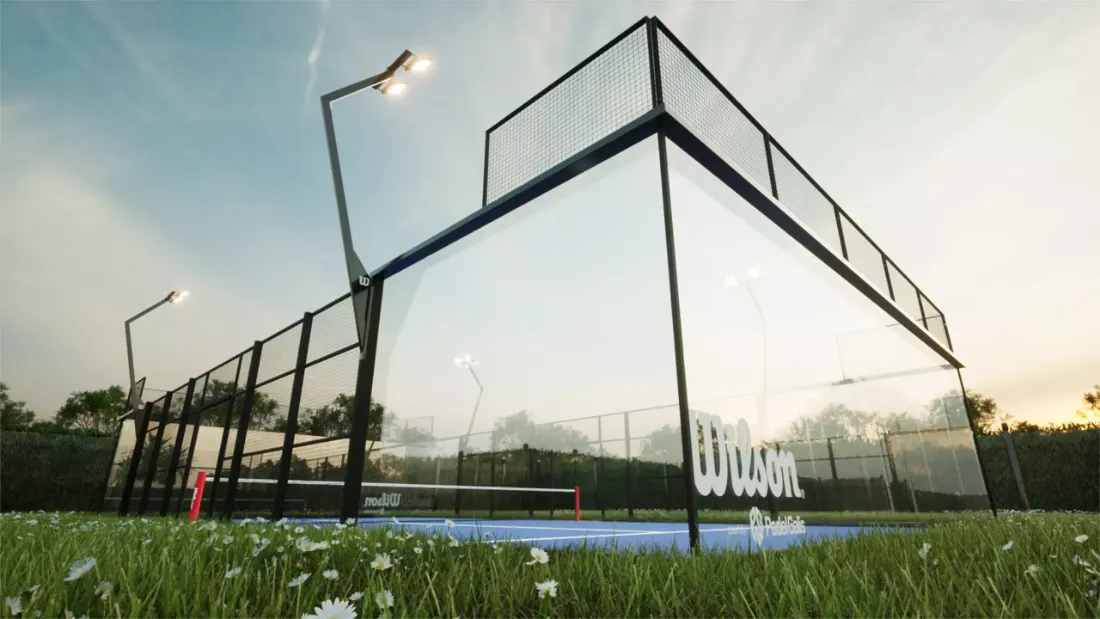
- Back walls 10 m wide, made of 3 m of glass (or solid wall) topped by 1 m of metal mesh, for a total height of 4 m.
- Side walls that step down from the back. Near each back wall, glass continues at 3 m and then 2 m for a short stretch. The middle of each side is open mesh, usually up to 3 m, with the access openings near the net.
The glass is tempered safety glass, typically 10 or 12 mm thick. Panoramic courts replace the posts at the back with structural glass so spectators can see the whole court, which makes them popular as show courts.
The walls matter for the rules too. Under the FIP rules in force since 1 January 2026, a return must bounce in the opponents' court before it touches their glass or mesh, and a serve that lands in the box and then touches the metal mesh is a fault.
How much height above the court?
Lobs are a central shot in padel, so the space above the court matters. The FIP sets a minimum clear height of 6 m above the playing surface, with nothing hanging into that space. For indoor clubs, more is better: 7 to 8 m gives players room to lob comfortably, and top-level events use far higher halls.
If you are converting an existing building, measure the lowest point (beams, lights, ventilation) rather than the highest.
How much land does a court need?
The court is 20 × 10 m, but you also need room for the structure, access and circulation. As working figures for planning:
- per court: about 21 × 11 m including the frame;
- between courts: 1.5 to 2 m so players and spectators can walk safely;
- around the group of courts: paths, lighting columns if outdoors, and space for benches and equipment.
If you want players to be allowed to run out of the court through the side openings, the FIP rules also ask for a clear safety area outside each opening. Check this with your court builder before you fix the layout.
A common rule of thumb is that the footprint of one tennis court, with its run-off, can host two or three padel courts, depending on layout and access.
Surface and lighting
Most padel courts use artificial grass with sand infill, which gives a consistent bounce and some grip. Some clubs use textured acrylic or cement, particularly outdoors in dry climates. Whichever you choose, the surface must be level and drain well outdoors.
Lighting should be even across the whole court and placed so players are not dazzled when they look up for a lob. Outdoors, lights usually sit on columns at the sides; indoors, fittings sit above and outside the main line of play.
How padel compares with tennis and pickleball
- Padel: a 20 × 10 m playing area (about 66 × 33 ft), a net 88 cm high at the centre, glass and mesh walls that are in play, usually four players.
- Tennis (doubles): 23.77 × 10.97 m inside the lines (78 × 36 ft), a net 91.4 cm high at the centre, no walls but run-off around the court, two or four players. Details in our tennis court dimensions guide.
- Pickleball: 13.41 × 6.10 m (44 × 20 ft), a net 86.4 cm high at the centre, no walls, two or four players.
The padel court is slightly smaller than a tennis court's lines and needs no run-off behind the baseline, because the walls are part of the game. That is why padel fits so efficiently on a plot. A pickleball court is smaller still, about a third of a padel court's area.
Planning checklist
Before ordering a court, check:
From courts to bookings with PLAI
Pay nothing. Get everything. PLAI is 100% free to run your venue: no subscription, no contract, no limits. Each court becomes a space in your calendar with its own opening hours and prices; players and members book it, pay their share and invite their partners from the app; your team can block a court for maintenance; and the analytics show how full each court is, hour by hour, which helps when you plan the next ones. See PLAI Business, or read why tennis clubs are adding padel.
FAQ
What size is a padel court?
20 × 10 m inside the walls (about 65 ft 7 in × 32 ft 10 in), or 200 m².
How high is a padel net?
88 cm at the centre and up to 92 cm at the posts.
How high must the ceiling be for indoor padel?
At least 6 m of clear height under FIP rules; 7 to 8 m is more comfortable.
How much land do I need for one padel court?
About 21 × 11 m for the court and its frame, plus space for access between and around courts.
How many padel courts fit on a tennis court?
Usually two or three on the footprint of one tennis court with its run-off.